

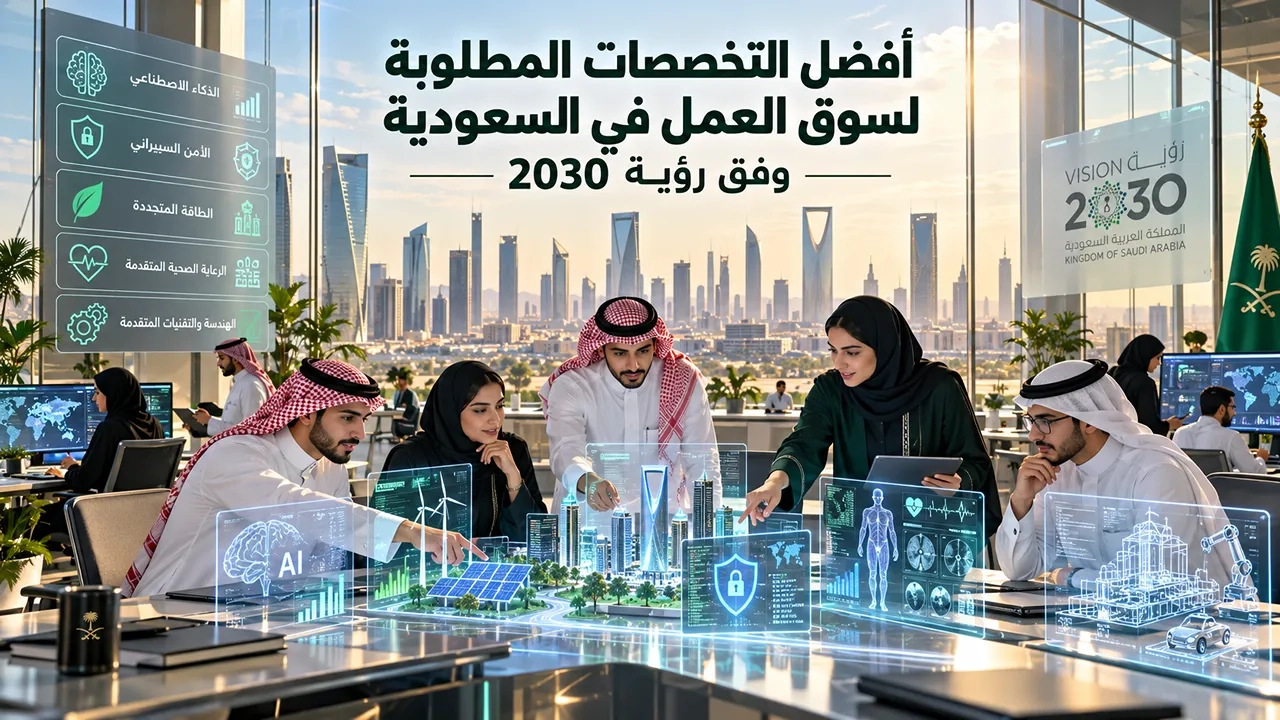
With the launch of the third phase of Saudi Vision 2030 in 2026, employment criteria in the Saudi market have fundamentally shifted following the actual enforcement of mandatory Saudization (localization) decisions and the launch of the Unified National Admission Platform (Qabool). If you are planning to enroll in university this year, relying on previous traditional lists may direct you toward saturated paths or fields legally restricted to specific groups, making a thorough search for in-demand majors in Saudi Arabia a crucial step to secure your professional future.
This updated guide for 2026 and 2027 provides you with a practical roadmap based on the latest decisions of the Ministry of Human Resources and Social Development and the tracks of the Custodian of the Two Holy Mosques Scholarship Program. Through it, you will learn about the fundamental differences between priority majors for Saudi citizens and those available to expatriate students, and how to study these fields in accredited Turkish universities that ensure degree equalization and successful professional practice.
Top In-Demand Majors in Saudi Arabia for 2026 and 2027
The year 2026 witnessed the transition of major national giga-projects from the founding phase to the actual operational and capacity expansion phase, which rearranged hiring priorities across both the public and private sectors. According to the approved lists of the Saudi Ministry of Education, current and future needs are concentrated in four main sectors:
1. Advanced Technical and Digital Majors
Information and communications technology (ICT) fields top the demand list to operate the infrastructure of smart cities and government and financial platforms, including the following majors:
- Artificial Intelligence: Focuses on building intelligent algorithms, machine learning, and automating operational processes across industrial and service sectors.
- Cybersecurity: Concerned with protecting sensitive networks and systems in banks and energy facilities from cyber threats. You can read Studying Cybersecurity in Turkey 2026: A Guide to the Digital Future to learn about academic courses and required skills in this field.
- Software Engineering: Specializes in designing and developing cloud systems and large-scale digital applications according to international standards.
- Quantum Computing: One of the precise disciplines included in modern scholarship tracks to process big data and complex computations in research centers.
2. Updated Engineering Majors and Renewable Energy
Pay close attention: Many fall into a common scientific misconception by describing mechanical, electrical, and industrial engineering as new majors; the academic fact is that they are classic, fundamental engineering disciplines, but in 2026 they are undergoing a comprehensive update in their specialized sub-tracks to include digital manufacturing technologies and automation.
- Renewable Energy Engineering: Serves solar energy, wind energy, and green hydrogen production projects to achieve sustainability targets and reduce reliance on fossil fuels.
- Industrial Engineering and Digital Manufacturing: Integrates engineering management with robotics and 3D printing technologies to enhance the efficiency of national factories.
- Environmental Engineering: Focuses on water resource management, waste treatment, and ensuring construction projects adhere to strict environmental standards.
- Advanced Electrical and Mechanical Engineering: Focuses in its modern tracks on smart power grids, electric vehicles, and automated control systems.
3. Giga-Project Majors and Emerging Sectors
Saudi giga-projects such as NEOM, the Red Sea Project, and Qiddiya have driven unprecedented demand for niche, qualitative majors that did not experience such momentum in previous years:
- Luxury Tourism and Hospitality: Prepares qualified personnel to manage world-class resorts and luxury hotels, and develop integrated tourism experiences.
- Aviation Science and Airport Management: Keeps pace with the major expansion of national airline carriers and the development of new hub airports in the Kingdom.
- Supply Chain Management and Logistics: Supports the strategy of transforming the Kingdom into a global logistics hub connecting three continents through ports and special economic zones.
- Biotechnology: Combines natural sciences and technology to develop pharmaceutical industries, food security, and genetic solutions.
To compare these fields with regional and international employment trends, you can review the guide Top 10 In-Demand University Majors: Your Guide to the Gulf and Global Job Market 2025.
4. Healthcare and Allied Medical Majors
The healthcare sector continues to expand to keep pace with population growth and the goals of the Quality of Life Program, driving demand for the following branches:
- Human Medicine and Dentistry: Particularly in surgical and specialized subfields to meet demand in medical cities and specialized hospitals.
- Nursing and Critical Care: Represents the highest-demand major in terms of headcount across all public and private healthcare facilities.
- Rehabilitation Sciences and Occupational Therapy: Experiencing increasing demand in medical rehabilitation centers and extended care facilities. You can explore the details of studying it through the article Studying Occupational Therapy in Turkey: Career Fields and Best Universities 2026.
- Health Informatics and Clinical Pharmacy: Connect medical sciences with digital health systems management to ensure the efficiency of pharmaceutical care.
New Saudization Decisions in Saudi Arabia and Their Impact on Choosing a Major
Choosing a university major in 2026 differs from 2025 as a result of a package of ministerial decisions issued by the Ministry of Human Resources and Social Development, which raised localization (Saudization) rates in administrative and specialized professions to record levels:
- 100% Localization of Administrative Support Professions: Based on Ministerial Decision No. 132249, mandatory enforcement to fully localize these professions in private sector establishments begins on October 4, 2026. The decision covers 69 professions in the Saudi Standard Classification of Occupations, most notably: human resources management and development, public relations, secretarial work, translation, and clerical logistical professions such as shipping and customs agents.
- Raising the Localization of Engineering Professions to 30%: According to Ministerial Decision No. 93483, the private sector (for establishments employing 5 or more workers in engineering professions) is required to raise the proportion of Saudi engineers to 30% starting June 30, 2026.
- Raising the Localization of Dentistry Professions to 55%: The second phase of dentistry localization in the private sector came into effect on January 27, 2026, for establishments employing 3 or more workers. According to the Ministry of Health and the Ministry of Human Resources and Social Development, to calculate a Saudi dentist within the localization percentage, their wage registered with social insurance must not be less than 9,000 Saudi Riyals, along with holding valid accreditation from the Saudi Commission for Health Specialties (SCFHS).
- Raising the Localization of Project Management Professions to 70%: The Ministry of Human Resources and Social Development, in partnership with the Ministry of Municipalities and Housing, issued a decision to raise the localization rate of project management professions (Project Management Director, Project Management Engineer, Project Management Specialist) to 70% in private sector establishments with 3 or more workers, with mandatory enforcement starting on February 14, 2027.
Note: These decisions mean that administrative support majors and project management have become golden career paths with guaranteed employment for Saudi citizens, while they are no longer a viable option for non-Saudi students wishing to enter the Saudi job market after graduation.
The Difference Between In-Demand Majors for Saudi Citizens and Expatriate Students
If you are looking for in-demand majors in Saudi Arabia, it is essential to distinguish between market needs that are open to everyone and professions covered by exclusive Saudization quotas. The job opportunities available in 2026 and 2027 vary significantly based on the graduate's nationality:
- Exceptional Opportunities for Saudi Citizens: Human resources, public relations, translation, project management, and dentistry majors represent excellent choices for Saudi citizens; new regulations require private sector companies to hire Saudis at rates ranging between 55% and 100%, alongside minimum wage thresholds in the medical and engineering sectors.
- Most Suitable Paths for Expatriate Students (Arab and Foreign): If you are a student residing in the Kingdom or studying abroad and aspire to work in Saudi Arabia in the future, you must direct your focus toward specialized technical disciplines, advanced engineering branches, and high-skill professions that are not completely restricted to Saudis, where major companies still require international expertise to fill the remaining non-localized quotas.
To explore technical options that grant you broad opportunities across regional markets, we recommend reading the article The Best Technical Majors in the Turkish Market and Future Job Opportunities.
Vision 2030 Majors and the Custodian of the Two Holy Mosques Scholarship Program Tracks 2026
The Human Capability Development Program, launched by the Kingdom in September 2021 as one of the Saudi Vision 2030 realization programs, works on direct alignment between university outputs and market needs, and increasing student enrollment rates in Science, Technology, Engineering, and Mathematics (STEM) majors.
In implementation of this strategy, the Custodian of the Two Holy Mosques Scholarship Program, affiliated with the Ministry of Education, is divided into specific tracks serving the labor market:
- Pioneers Path: Sends students on scholarships to the top 30 educational institutions globally across various leadership and scientific disciplines without restriction to a single field.
- R&D Path: Focuses on postgraduate studies and research fields of national priority, such as biotechnology and clean energy.
- Imdad Path: Aims to bridge direct labor market gaps by sending students on scholarships to the top 200 universities and educational institutions globally, covering 8 specific fields for bachelor's and master's degrees, including communications and information technology, engineering and manufacturing, digital economy, and supply chain management.
- Wa'ed Path: Operates on a scholarship-for-employment mechanism to train and qualify students in cooperation with major corporations in emerging national sectors and projects.
- Health Agreements Path: Dedicated to training physicians and healthcare practitioners in accredited international universities and medical centers.
Pay close attention to official updates in 2026: The application mechanism for universities and scholarships underwent two fundamental changes that every student must know:
- Launch of the Unified National Admission Platform (Qabool): Applications to public and private universities, the Technical and Vocational Training Corporation (TVTC), and the Custodian of the Two Holy Mosques Scholarship Program were unified into a single national portal via the official website (uap.sa).
- Additional Requirements for the Scholarship Preparatory Year: The Ministry of Education imposed new conditions (starting from the 2025-2026 academic year) for studying the undergraduate preparatory year, stipulating that the high school GPA must not be less than 90% and the English language test (IELTS) score must not be less than 5.5, along with specific requirements introduced for applicants to universities in China and Germany.
Best University Majors with a Promising Future for Women in Saudi Arabia 2026
Legislation supporting women's empowerment has contributed to raising the participation rate of female competencies in the Saudi job market to unprecedented levels. If you are looking for a university major that combines job security and rewarding financial returns in 2026, the most promising fields include:
- Modern Digital and Financial Majors: Cybersecurity, data science, digital economy, and financial technology (FinTech) top the choices of female graduates to work in central and commercial banks and government authorities.
- Executive Management and Project Management: Saudi female graduates benefit directly from the decision to localize administrative support professions by 100% (as of October 2026) and project management professions by 70% (as of February 2027), providing immediate opportunities in human resources management, public relations, and translation.
- Luxury Tourism, Event, and Conference Management: With Saudi cities transforming into global destinations for international exhibitions, conferences, and entertainment tourism, these majors have emerged as vital and stable career paths for women.
- Health and Rehabilitation Sciences: Includes clinical pharmacy, clinical nutrition, physical therapy, and medical laboratories—disciplines in high demand across hospitals and health centers throughout the Kingdom.
To learn about study options available for female students wishing to study abroad, you can review The Best University Majors in Turkey 2026 and Their Future in the Labor Market.
How to Choose the Right University Major in Saudi Arabia? (Practical Steps)
To avoid randomness in choosing your academic path, follow these systematic steps based on official tools approved in the Kingdom:
- Review National Labor Observatory (NLO) Reports: Visit the official portal managed by the National Labor Observatory to view accurate data and statistics on graduate employment rates and average salaries for each major and university in the Kingdom before making your decision.
- Align Interests with Qabool Platform Lists: Compare your personal aptitudes and high school GPA with the lists of approved majors in the Imdad and Wa'ed tracks via the Unified National Admission Platform (Qabool) to ensure choosing a field aligned with national priorities.
- Study the Impact of Saudization Decisions on Your Category: Determine your legal position regarding the Saudization decisions for 2026 and 2027; if you are a Saudi citizen, focus on professions with high localization rates, and if you are a resident, choose specialized technical and engineering majors.
- Verify Professional Accreditation Requirements in Advance: Review the professional classification and registration requirements for the target profession, such as membership requirements for the Saudi Council of Engineers (SCE) or professional licensing criteria from the Saudi Commission for Health Specialties (SCFHS).
Studying In-Demand Majors at Turkish Universities Recognized in Saudi Arabia
Many Saudi students and residents in the Kingdom turn to studying engineering, technical, and medical majors at Turkish universities, either due to the strength of academic infrastructure and the availability of English-medium study, or as a practical alternative for students who did not meet the requirement of a 90% high school GPA or a 5.5 IELTS score required for the preparatory year in the scholarship program.
To ensure the success of your academic step in Turkey and the accreditation of your degree upon returning to the Kingdom, the following guidelines must be observed:
- Choose an Officially Recommended University: Make sure the Turkish university is listed among the recommended universities by the Saudi Ministry of Education in the required major and academic degree, in order to guarantee degree equalization (Denklik) and practice in both public and private sectors. You can review the list of Top Turkish Universities Recognized in Saudi Arabia for 2025 and Their World Rankings to check accredited universities.
- Benefit from Quality Laboratories and English-Medium Programs: Turkish universities accredited by the Turkish Council of Higher Education (YÖK) offer advanced programs in English or Turkish in artificial intelligence, cybersecurity, mechanical and electrical engineering, and dentistry at competitive tuition and living costs.
- Fulfill Saudi Professional Body Requirements After Graduation: Medical and healthcare college graduates from foreign universities are required to pass the exams of the Saudi Commission for Health Specialties (SCFHS), while engineering college graduates must obtain professional accreditation from the Saudi Council of Engineers (SCE) to practice the profession in the Saudi market.
Frequently Asked Questions
What are the most in-demand university majors in the Saudi labor market under Vision 2030?
Information and communications technology majors (artificial intelligence, cybersecurity, software engineering, quantum computing) top the demand list, followed by updated engineering disciplines (renewable energy and digital manufacturing), supply chain management and logistics, luxury tourism and hospitality, aviation, and biotechnology.
What professions and majors are covered by the new Saudization decisions in Saudi Arabia for 2026 and 2027?
The new decisions include 100% localization of 69 administrative support professions (such as human resources, public relations, and translation) starting October 4, 2026, raising localization of engineering professions to 30% on June 30, 2026, localizing dentistry professions by 55% in January 2026, in addition to raising localization of project management professions to 70% starting February 14, 2027.
How do I find out the employment rate for graduates of my university major in Saudi Arabia?
You can officially and accurately determine graduate employment rates and average salaries for each major and university through periodic reports and data published by the National Labor Observatory (NLO) via its official electronic portal.
What are the majors of the Imdad and Wa'ed tracks in the Custodian of the Two Holy Mosques Scholarship Program 2026?
The Imdad track focuses on meeting direct labor market needs by sending students on scholarships to the top 200 universities globally across 8 specific fields for bachelor's and master's degrees (such as technology, engineering, and digital economy), while the Wa'ed track focuses on scholarship-for-employment programs and training students in emerging national sectors and projects.
Is studying engineering and medicine in Turkish universities recognized and in demand in the Saudi job market?
Yes, provided that the Turkish university is included in the list of universities recommended by the Saudi Ministry of Education upon enrollment, alongside the necessity for the graduate to pass the Saudi Commission for Health Specialties exam (for doctors and healthcare practitioners) or obtain accreditation from the Saudi Council of Engineers after graduation.
The Role of Skyline Education in Securing Your Academic Future
Your success in entering the Saudi job market for 2026 and 2027 begins with accurately reading the numbers and regulatory decisions before sitting in university lecture halls. Always make sure to choose a major that integrates digital skills with practical application, and ensure it aligns with official accreditation lists in the Kingdom to avoid any legal obstacles after graduation.
If you are planning to study an engineering, technical, or medical major in Turkey, the Skyline Education team places its academic expertise at your disposal to guide you toward Turkish universities recommended by the Saudi Ministry of Education. We offer free and guaranteed university admission services, exclusive discounts through our certified agency with top private universities, along with full proxy services to complete registration procedures and document equalization before your arrival in Turkey.