
Imagine spending 4 years of your life studying engineering or medicine, working day and night, and graduating with an excellent GPA. Then, the opportunity of a lifetime comes to work in Germany or complete a Master's in Italy, only to hit a solid wall: "Sorry, your degree system is not understood by us." This nightmare is exactly what the "Bologna Process" came to end.
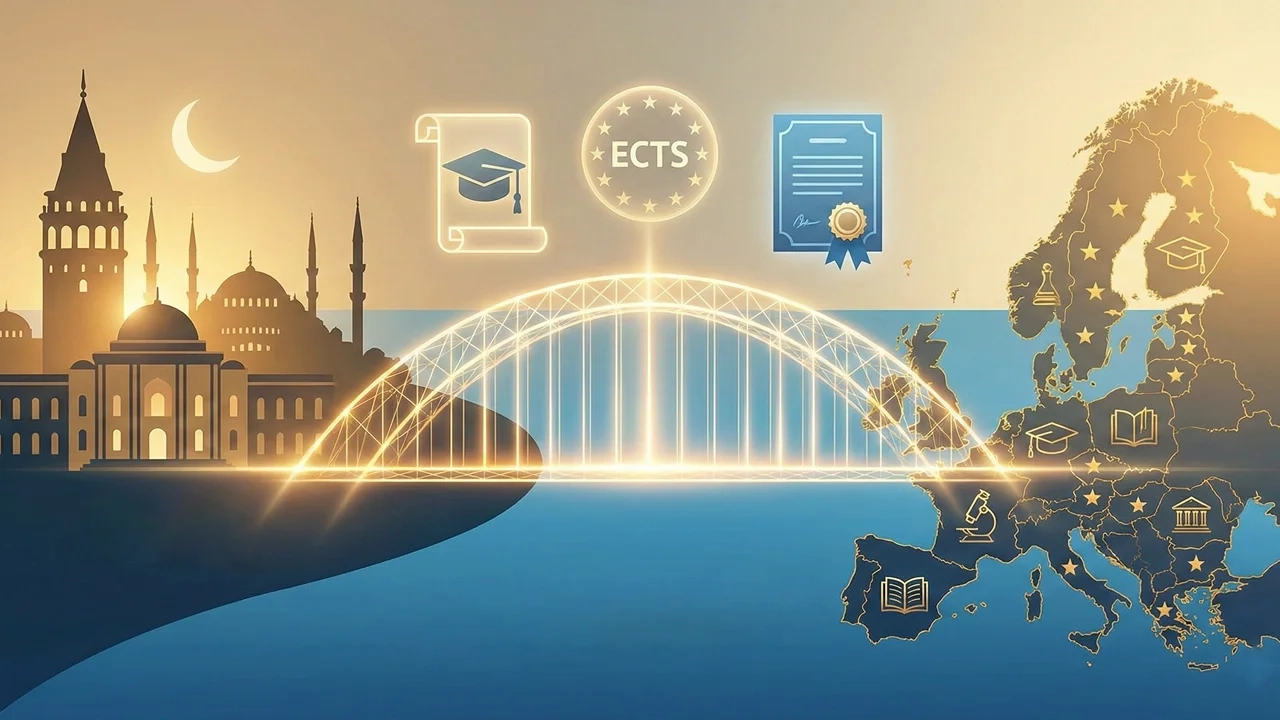
When you choose to study in Turkey, you are not just choosing educational quality or reasonable costs; you are choosing a country that has been a full member of the European Higher Education Area (EHEA) since 2001. This means the degree you hold is not just a local paper, but a document designed with standards to be understood by any admissions officer or employer from London to Istanbul.
In this comprehensive guide from Skyline Education, we will reveal the truth about the "Blue Diploma," how the European Credit Transfer System (ECTS) works, and why Turkey is your smart gateway to a global future.
What is the Bologna Process Simply?
The Bologna Process is not just the name of a beautiful Italian city; it is the largest agreement to standardize higher education standards in the world. Its primary goal is to make educational systems in member countries (currently 49 countries, including Turkey) compatible and readable.
Simply put, it is the common language that makes a Bachelor's degree from Istanbul University "speak" the same language as a Bachelor's degree from the Sorbonne University in France. Without this system, a student would need to undergo complex equivalency procedures and provide a detailed explanation of every subject studied to prove their competence.
The Three Pillars of the Bologna System in Turkey:
- The Three-Cycle System: (Bachelor's, Master's, PhD) with standardized durations.
- European Credit Transfer System (ECTS): For the ease of calculating and transferring study subjects.
- Quality Assurance: Strict standards imposed by accreditation institutions to ensure the level of education.
The Password: European Credit Transfer System (ECTS/AKTS)
In Turkish universities, you will hear the term "AKTS" often, which is the Turkish abbreviation for (ECTS). This system is the unified currency of education. Instead of calculating studies by "number of years" only, they are calculated by the "workload" required from the student.
According to the standards of the Council of Higher Education (YÖK), which are compatible with Bologna, points are distributed as follows:
- Bachelor's (Lisans): Requires completing 240 ECTS (usually 60 points per academic year over 4 years).
- Master's (Yüksek Lisans): Requires between 90 to 120 ECTS.
- PhD (Doktora): Requires an additional 240 ECTS.
Why Does This Number Matter to You?
If you decide in your second year to transfer from a Turkish university to a European university, or even transfer between universities within Turkey, the ECTS system makes the process extremely smooth. The new university will look at your transcript, see that you have completed "60 ECTS" in the Engineering major, and directly equate your degree without you having to repeat the year.
The Blue Diploma (Mavi Diploma): Fact or Marketing Fiction?
Many students ask us at Skyline Education: "Does this university give the Blue Diploma?". The answer is: What is called the Blue Diploma is actually the "Diploma Supplement" (DS).
This document is the fruit of the Bologna system, and it is issued by most Turkish universities (prestigious public and private ones) for free upon graduation and in English.
What is Inside the Diploma Supplement?
- Level: The type of degree and its position in the national educational structure.
- Content: A list of subjects, grades, and ECTS points for each subject.
- Eligibility: Clarification of the rights granted by this certificate (such as the right to pursue postgraduate studies).
Important Warning from Skyline Experts: Possessing the Diploma Supplement (Blue Diploma) does not mean you automatically receive a work visa or cancel the need for a professional practice license in countries like Germany (especially for medicine and engineering). It is a document that facilitates recognition and makes the employer understand your degree immediately, but it does not override the immigration and labor laws in those countries.
Are Turkish Universities Really Recognized in Europe?
Yes, and strongly so. Turkey has been a full member of the "European Higher Education Area" since 2001. This means that the education system in Turkey is subject to the same monitoring and quality standards applied in the European Union.
However, recognition is of two types:
- Academic Recognition: (To complete Master's and PhD) which is very smooth thanks to the Bologna system.
- Professional Recognition: (To work as a doctor or engineer) This is subject to the laws of the unions/guilds in each European country individually, but graduating from a university that applies Bologna standards shortens half the way for you in equivalency procedures.
How Does "Skyline Education" Help You Utilize This System?
Not all universities apply Bologna standards with the same efficiency. Some Turkish universities hold the mark of excellence "ECTS Label" from the European Commission, which gives their degree heavier weight.
Our role at Skyline Education is not limited to securing admission, but:
- We recommend universities that grant the Diploma Supplement (DS) automatically.
- We clarify the differences in international recognitions for each major, especially in future majors and engineering.
- We help you prepare your file to ensure your acceptance into universities with strong partnerships with the European Union (Erasmus programs).
Frequently Asked Questions About the Bologna System in Turkey
1. Do all Turkish universities apply the Bologna system?
Officially, yes, all Turkish universities are obliged to apply the Council of Higher Education standards compatible with Bologna. However, the quality of implementation and the depth of international partnerships (Erasmus+) vary from one university to another.
2. Can I transfer from a Turkish university to a German university after a year?
Yes, this is possible thanks to the ECTS system. You will need to submit a transcript showing the points you have accomplished, and shared subjects are often calculated, saving you time and money.
3. Is the Blue Diploma necessary for work in the Gulf?
Gulf countries rely on their own recognition lists (such as the Ministry of Higher Education lists in your country). However, the presence of the Diploma Supplement strengthens your file and proves that your education was according to global standards, which makes you preferred in multinational companies.
Start Your Future from Turkey
Your study in Turkey is not just a passing phase, but a smart investment that grants you a degree with global flexibility and competitive costs. Do not leave the choice of your university to chance; ensure that it puts you on the right path towards globalization.
Do you want a list of Turkish universities that grant the "Blue Diploma" and are distinguished by the strongest European accreditations? Contact us now at Skyline Education for a free consultation.